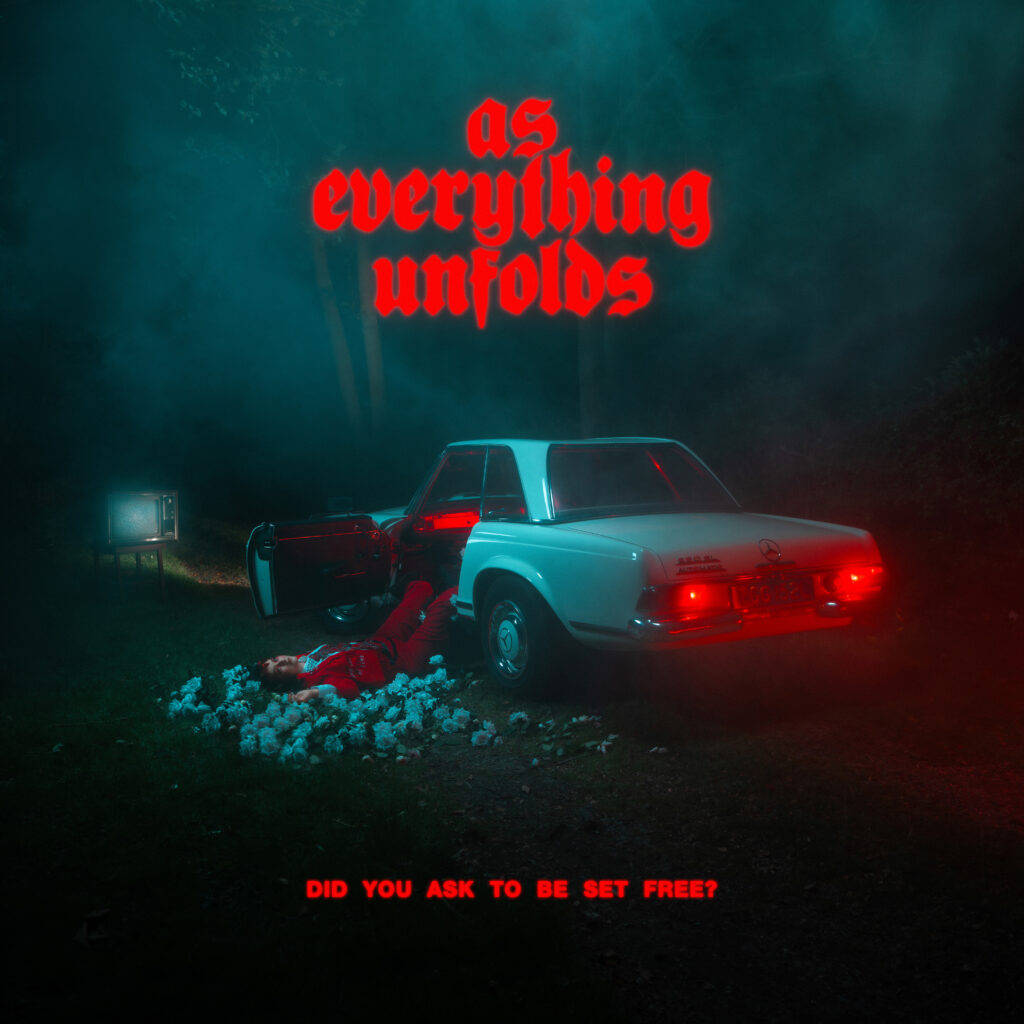
“Written in two halves, before and after tragedy, this is the most honest thing As Everything Unfolds have ever put their name to.”
There’s a question buried in this album’s title, and it doesn’t have a clean answer. Set free from what, exactly? From who? Charlie Rolfe has her own answer — maladaptive daydreams, comfort in fantasy, the fear of facing reality head on. But the beauty of it is that you’ll find your own. That open-endedness is intentional, and it’s the first sign that this is a band operating with real purpose.
Did You Ask to Be Set Free? is As Everything Unfolds‘ third album, their first on Century Media, and almost certainly the hardest thing they’ve ever made. Partway through writing it, they lost their drummer Jamie Gowers. Charlie has spoken openly about the record feeling like two halves — before and after. That you can’t hear the join is a testament to how completely the band pulled themselves back together, and how much of themselves they poured into finishing it.
It opens with “Denial,” and the mood is immediately clear. This isn’t a heartbreak record. It’s about something more specific and more exhausting — loving someone whose self-destruction becomes your problem. “Do you enjoy your destruction of me?” Rolfe asks, and it doesn’t sound like an accusation. It sounds like someone who has genuinely run out of other explanations. The line that stays with you comes quietly mid-track: “Love is conditional, not something that’s owed to you.” That’s a conclusion you reach after a long time of trying to believe otherwise.
“Gasoline” follows and deliberately muddies the waters. Where “Denial” is clear-eyed, “Gasoline” is self-aware about its own mess. Charlie isn’t playing a clean victim here. “I won’t let you take the blame, and I won’t let you let me go” is someone who understands exactly what’s happening to them and walks toward it anyway. Adam Kerr has admitted it wasn’t anyone’s favourite during recording precisely because it was so obviously good — they wanted to root for the underdogs. That honesty says a lot about how this band thinks. It’s the most immediate thing on the record and it earns every bit of the audience it’s going to find.
“Point of View” captures something that rarely gets written about honestly: the hollow feeling of being right. The relationship is over, the decision has been made, and there’s no triumph in it. “You will know in the end why I knew I had to leave.” That line is exhausted. It belongs to someone who wanted to be proven wrong and wasn’t. “Find Another Way” keeps that same energy but pushes it somewhere more urgent, the sound of someone who has processed the loss and is now figuring out what comes next. It sits in that darker, more thought-provoking corner of the record that Adam described as giving weight to everything around it.
“Cut The Lies” is the album’s shortest and sharpest moment, a track that doesn’t waste a second. Where some songs here sit with their feelings, this one has already made its mind up. “Break It Away” follows in a similar spirit, pushing forward rather than looking back, and together they give the middle of the record a momentum that stops it from ever sagging.
“Set in Flow” is where things turn inward. The other person is gone and what remains is the silence they leave behind and the uncomfortable question of what you do with it. “Frozen in my vengeance, dreams of purpose set in flow” — the idea that bitterness can become its own kind of trap, as suffocating as whatever you escaped. Musically it’s one of the most adventurous things here, the band deliberately pulling themselves outside their usual structures, experimenting with textures and electronics in a way that feels purposeful rather than restless. Charlie has called it one of the moments where they took themselves completely outside their conventional framework, and it shows in the best way.
“What You Wanted” is the album’s darkest moment. By this point Charlie is somewhere past exhaustion — numb, dissociated, going through the motions. Bury Tomorrow’s Dani Winter-Bates came on board after a simple text message following their late 2024 tour together, and the casualness of how it happened makes the track feel more genuine for it. He doesn’t arrive to rescue the song. He mirrors the spiral from a different angle. Two voices, same collapse. It earns every bit of its heaviness.
“Idols” pulls back and asks bigger questions — about who we look up to, what we project onto them, and what happens when that illusion breaks. It’s one of the more outward looking moments on an otherwise deeply personal record, and that shift in perspective gives it a different kind of weight.
Then there’s “Reverie.” Adam wasn’t wrong when he called it the wildcard. It sounds like nothing else on the record — an industrial, almost danceable pulse underneath something far more unsettled. He predicted people would either love it or find it strange. He’s probably right on both counts. But that strangeness is exactly what the album needs at this point, a reminder that this band refuses to be pinned down.
“Edge of Forever” stops everything dead in the best way. Where the record has been pulling and pushing, this one just sits with you. It’s softer, more considered, and more vulnerable than almost anything else here. Adam talked about needing songs like this to give the heavier tracks their weight — you need the other side of the coin to feel the full force of everything surrounding it. No human is one thing all the time, and “Edge of Forever” is the sound of a band refusing to pretend otherwise. It’s the album’s quiet peak and the moment most likely to stay with you long after the record ends.
“Setting Sun” closes everything. Charlie has said it was the hardest song to finish — written in grief, about grief, for Jamie, and for everyone around her carrying the same loss. She wrote it hoping that anyone going through something similar would feel less alone in what they were feeling. It shows in every second of it. It doesn’t wrap things up neatly or offer easy comfort. It just holds the weight of everything that came before it and asks you to sit with it.
Adam said he wants listeners to reach the end of this record feeling hope. That things can get better. That you can push forward and grab life with both hands. “Setting Sun” delivers that without ever saying it outright, which is the hardest thing a closing track can do and the most powerful when it works.
Thirty million streams and a decade of work from a band that started in a front room playing Paramore covers. From there to Wembley Arena, to Download, to Wacken, to Century Media, and now to this. Charlie’s parting thought on what she hopes listeners take from the record says it plainly: if you feel like you’re in a place of despair, don’t ever feel like you can’t create something beautiful out of it.
Did You Ask to Be Set Free? is proof she means it.




I’m Drew, the founder and editor of Front of the Stage. I have a strong love for music and photography, which started at a very young age. There’s just something I love about experiencing live music and capturing memories that will last a lifetime, and that’s how Front of the Stage came to be.