There’s a moment about forty seconds into “Corinthian Leatherface” where the fuzz opens up like a chest wound and Marc Gaffney’s voice cuts through it — not screaming, not posturing, just singing, with the kind of weight that tells you immediately this guy has been sitting alone at night processing some genuinely rough shit. That moment is the thesis statement for Gozu VI, and the Boston quartet spends the next forty-odd minutes making good on the promise.
Six albums in, Gozu are doing something that most bands in the stoner/fuzz orbit either can’t or won’t: they’re getting more personal without getting smaller. Gozu VI is heavier and more guitar-forward than Remedy (2023), which was already excellent, but it’s the emotional specificity underneath all that glorious fuzz that separates this record from the pack. Gaffney spent two years channeling domestic chaos and personal wreckage into lyrics before a single note was tracked — and you can hear the difference. These aren’t bar-napkin sentiments dressed up in big riffs. Lines like “You took what’s mine / But I’m the one doing time” land because they sound lived-in, not constructed.
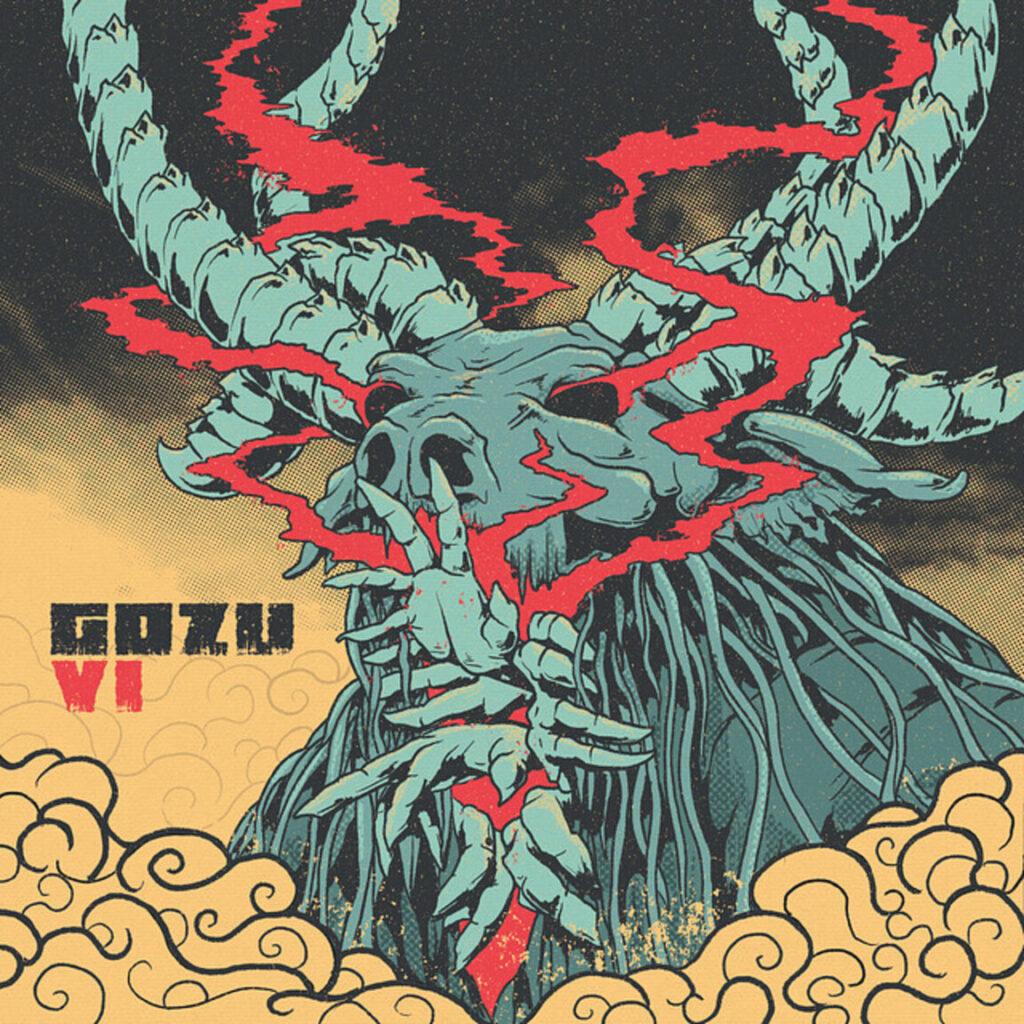
The album cover does the heavy lifting before you’ve hit play: a colossal ox-skull deity — Gozu of Japanese Buddhist mythology, guardian of hell — rises from decorative golden clouds, its massive curved horns split through with arterial red. Rendered in teal and amber with a vintage halftone grain, it’s the band finally planting their flag in the mythology their own name invokes. Six albums in, they’ve earned it.
Benny Grotto’s production at Mad Oak Studios is the right call. There’s clarity here without clinical sterility — you can hear Gaffney and Doug Sherman’s guitar tones breathe and interact, the low end from Joseph Grotto sits in the pocket without dominating, and Seth Botos’s drums, as more than a few people have already noticed online, sit perfectly in the mix. Not buried, not splashy — just locked in and propulsive, the way good rock drumming is supposed to feel.
“Banacek” is the obvious standout for newcomers: that Steve Harris gallop driving a hooky, melodic vocal line that genuinely earns the Iron Maiden comparison without cosplaying it. “Killer Khan” is the one that got me — a riff that opens with a nod to Townshend’s “Rough Boys” before pulling hard into something that sounds like Marshall Tucker and Allman Brothers left their gear running after closing time at a bar that serves Jameson in unwashed glasses. Sherman’s guitar work here is filthy and precise at the same time, a difficult trick that most people can’t pull off.
“Corner Lariat” is the closest thing to a ballad the album offers, and it’s genuinely affecting — all dreamy vocals and tinged-with-hope tonality, the sonic equivalent of a sunrise you weren’t sure you’d live to see. “They Did Know Karate” goes the other direction: slow, menacing, fuzz-saturated in a way that makes the room feel smaller. “Midnight Express” drags itself through six minutes of depressive weight like it’s hung over and proud of it. “Gimme the Lute” opens the diesel engine up and keeps it floored. “Corvette Summer” ends the record with harmonies and power that stop just short of triumphant — more like a person who made it through something difficult than someone who won clean.
The Queen-meets-QOTSA-meets-Motown vocal approach on “Corinthian Leatherface” is the strangest and most successful experiment here. Nobody is doing that particular combination, and the fact that it works says something about how far Gaffney has pushed his vocal range on this record — trying things, as he’s said, that he didn’t feel confident enough to attempt before.
What Gozu have always understood, and what Gozu VI distills better than anything they’ve done, is that groove is the engine and soul is the fuel. You can’t fake either. These songs move because the band has spent fifteen-plus years learning where the pocket is, and they’ve earned the right to fill it with something raw and real.
If you’re having a hard year — and let’s be honest, most people are — this album will not fix it. But it will sit next to you in it, which is the better thing anyway.




I’m Drew, the founder and editor of Front of the Stage. I have a strong love for music and photography, which started at a very young age. There’s just something I love about experiencing live music and capturing memories that will last a lifetime, and that’s how Front of the Stage came to be.