

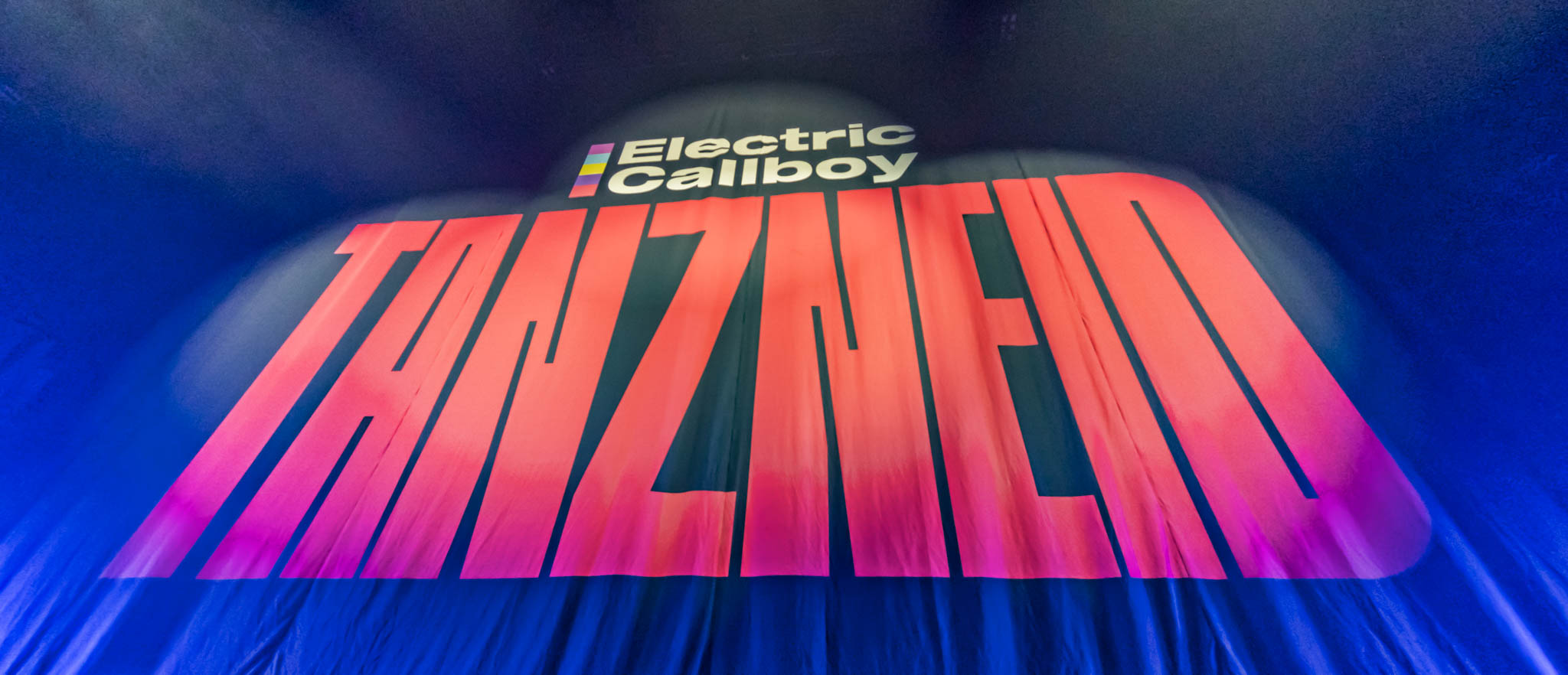
Before Electric Callboy played a single note, the parking lot at Exhibition Place was already telling a story. Lanes fenced off, white tents colonizing whole sections of the grounds — FIFA infrastructure eating up BMO Field’s surroundings like a slow tide. Inside Coca-Cola Coliseum, the other kind of takeover was underway.
Five thousand fans, and the room looked like a fever dream from a decommissioned MTV studio. Tracksuits, mullets, jogstu hats, neon wigs, fluorescent everything. Half the crowd had come dressed as the band. The other half had come dressed as the version of themselves that only exists at Electric Callboy shows.

Scene Queen opened and leaned fully into the bit — “Manicure,” “Pink G-String,” “Barbie & Ken” delivered with sharp hooks and the kind of confidence that either wins a crowd or loses it in the first thirty seconds. Toronto was won. Polaris followed and shifted the room’s center of gravity considerably. “Dissipate” hit like a pressure release valve, the pit self-organized immediately, and by “Hypermania” and “Nightmare,” bodies were already in the air. No hesitation, no calibration. Two openers that knew their jobs and did them.
Electric Callboy opened with “TANZNEID” and the room didn’t so much erupt as ignite along a very deliberate fuse. “Still Waiting” arrived early — the Sum 41 cover, with Dave Baksh stepping onstage wearing a patch-covered vest and a grin that said he was exactly where he wanted to be. Baksh is a pro and a performer, and he played it that way: full commitment, total energy, the kind of stage presence that makes a cameo feel like a headlining moment. It was a great rock and roll moment.

“Tekkno Train” and “Hypa Hypa” followed without pause for breath. “MC Thunder” and “Neon” turned the floor into a single organism. By “Pump It,” crowd surfing had gone from occasional to relentless. Then came the mash-up sequence — “Hurrikan,” “Overkill,” a chunk of “All the Small Things,” “Bodies” — spliced together like a DJ had gotten into the band’s setlist and decided cleanup was someone else’s problem. It was shameless and precise in equal measure. A Wall of Death split the room open. A circle pit spiraled out from the wreckage. The production fed into all of it: LED screen behind the drummer, strobes deployed as punctuation rather than spectacle, confetti timed for release rather than escalation. Balloons floated out at intervals, and nobody found it incongruous with the noise. That’s the trick Electric Callboy pull off that no one else really manages.
The drum solo arrived mid-set as a controlled exhale. Interactive visuals, the crowd clapping in sync, the kind of communal pause that resets the room rather than empties it. Then something stranger: a few band members walked off the stage and into the crowd. Sat people down. Told them to put the phones away. The Coliseum, 5,000 deep, went briefly and unusually still. An acoustic guitar. Kevin on keys. Nico on vocals. “Fuckboi” stripped back to its bones, and then the opening bars of “Everytime We Touch” drifting up from the middle of the floor. It shouldn’t have worked. The tenderness felt almost provocative after everything that came before. It worked completely.

They walked back to the stage and triggered another Wall of Death. Of course they did.
“MC Thunder II (Dancing Like a Ninja)” snapped the room back to full tilt. “Elevator Operator” closed the main set. The encore came in three stages: “RATATATA” with BABYMETAL energy flooding the room even in absentia, “Spaceman,” and then “We Got the Moves” as the final ignition — not a victory lap, more like flipping the kill switch on your way out the door just to watch one more thing catch fire.

Electric Callboy understand something most bands in their lane don’t bother to learn: the joke only works if the timing is immaculate. Every absurd moment in this set — the costumes, the mash-ups, the acoustic detour, the balloons, the robot visuals — was placed. None of it was filler. Toronto came prepared to lose its mind, and the band obliged with the seriousness of people who have spent years engineering exactly this kind of controlled detonation.
A huge thanks to Bernice Chan at Looters and Mahlet Sintayehu at Live Nation for the accreditation and support that made this review possible.
Electric Callboy


Polaris


Scene Queen




I’m Drew, the founder and editor of Front of the Stage. I have a strong love for music and photography, which started at a very young age. There’s just something I love about experiencing live music and capturing memories that will last a lifetime, and that’s how Front of the Stage came to be.
Related Posts

Backstage with Steve Via
Recently, I had the pleasure of attending the VIP Meet and Greet at Centre in […]
Pizza Bush at The Painted Lady: A Sizzling Slice of Music
If you’re seeking an evening of music that defies the ordinary, The Painted Lady on […]

Duran Duran’s “Future Past Tour 2023” Lights Up Toronto’s Scotiabank Arena
In the words of Duran Duran themselves, “Who do you need, who do you love […]