Look at the album cover long enough and it starts looking back at you. A rhinestone cross sits over Kitty Austen’s left eye, which is not an image of devotion. It is faith as blindfold. Behind her, red angel wings, the colour of something that has already bled. She is dressed like a schoolgirl and a dominatrix at once, white shirt, black gloves, and she is not performing for you. She is staring through you. The title sits right there in the frame like a warning already in progress. Your god fearing days are about to begin. Not a promise. Not an invitation. The days have already started. You are already in them.
The record itself operates the same way.
Your God Fearing Days Are About To Begin is the sound of a band who went into the studio with nothing to prove and came out with everything. The electronics don’t decorate the songs, they ARE the songs, grinding and surging underneath Kitty’s voice like something tectonic. And that voice. Unprocessed, unpolished, allowed to crack and push and growl and go somewhere uncomfortable. In 2026, when the industry default is to sand every vocal into something algorithm-friendly, the choice to leave it raw demands your attention in a way that most heavy records simply do not.
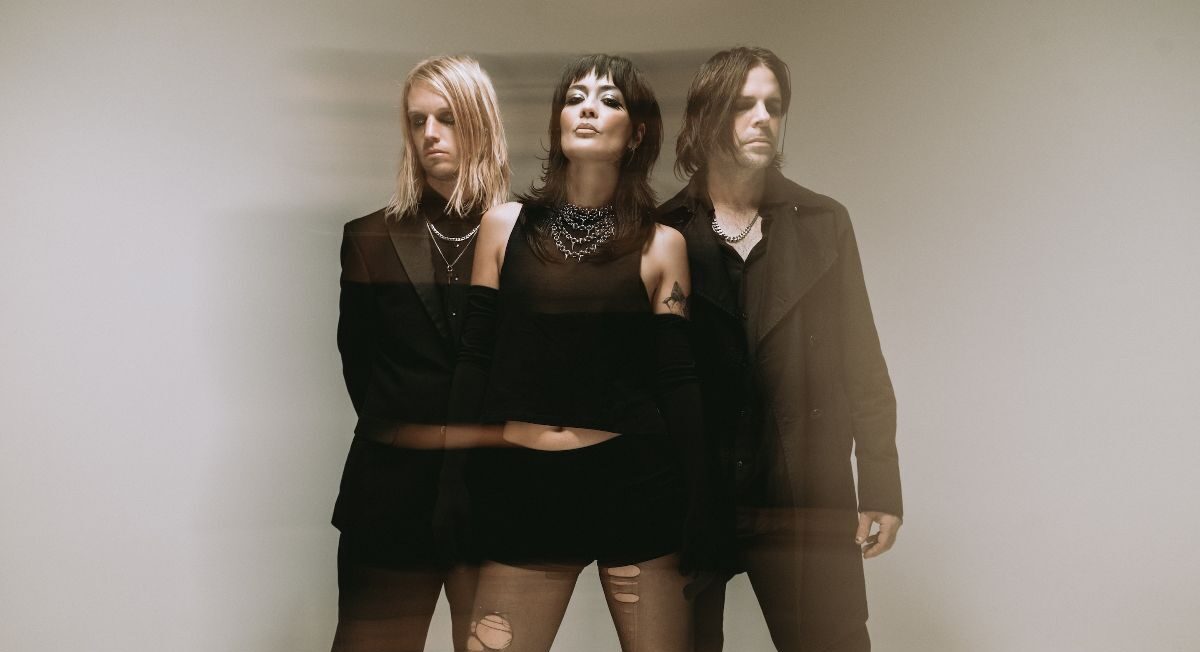
The band made this record themselves after an early attempt with an outside producer collapsed. They pulled it back, rebuilt it between the three of them, then sent it to Jim Pinder for mixing. His contribution, by their own account, was to change as little as possible. The result sounds exactly like that: a band’s vision realised with total fidelity, just louder and sharper than they could have made it alone.
Good Boy announces itself with a strutting industrial groove that takes about forty seconds to turn into something you cannot unhear. The “yes sir, no sir, please sir, thank you” chorus is a perfect piece of songwriting, simple enough to be immediately memorable and loaded enough to get worse the more you think about it. By the time the song reaches its middle section, that creeping dread underneath the hook has fully surfaced. “In a moment of quiet it’s awake and it’s violent, but everything’s fine, everything’s fine, get back in the line.” That is not a lyric you forget. The song ends not with a release but with the groove just continuing, pointedly, like the machine doesn’t care that you noticed.
The Father, The Son and The Holy Beast takes the album’s central image, the corrupted sacred, and runs it to its logical conclusion. The structure is almost ritualistic, that repeated “I’m right here, don’t be scared” threading through the whole track like a chant or a hex. The lyric pivots on a knife edge between tenderness and menace and you genuinely cannot tell which side you’re on at any given moment. “I was your good girl, always so chaste” into “flesh in my mouth, I like the taste” is not shock value. It is character. It is a specific kind of reclamation that a lot of listeners are going to recognise in their bones.
The Ghost does something quieter but equally unsettling. The central question, am I a ghost, can anyone hear me, exists or, is one of the album’s most relatable themes: alienation so complete it starts to feel physical. The line “I never wanted to live before, I got a taste and I want some more” arrives two thirds of the way through and recontextualises everything before it. This is not a song about disappearing. It is a song about someone who discovered they wanted to stay.
Song For Mia is where the armour comes fully off. It is a plainly stated, almost uncomfortably intimate piece of writing about friendship and grief and the particular sadness of who you thought you would be by now. “I miss you and I miss the me I thought I would be” is one of those lines that lands like a fist the first time you hear it and somehow hurts more on the second. The fact that it exists on the same record as Good Boy is a statement about range that most bands in this lane cannot make.
The Beast is the album’s most personal piece and the one the band are most proud of. Kitty wrote it as a complete song before a single note was recorded, every lyric, every melody, every chord already in place. Then they took it apart and rebuilt it. Hundreds of versions by their own admission, each one pulled back and reassembled until it finally felt true. It is a grief song, specifically about the necessity of going fully into pain rather than around it, and the lyric carries that weight without softening it. “Amongst all of that pain there is always light, there is always something you can learn.” The band worked harder on this than anything else here, months of rebuilding a song that runs five and a half minutes. You can hear why they needed to get it right.
The album has political nerves running through it, Good Boy and Gods of War most explicitly, but Saint Agnes have the sense to write politics through image rather than instruction. Nobody is being told what to think. The record presents a world recognisable as this one, identifies what is wrong with it, and leaves you to sit in that recognition.
This is the third Saint Agnes album and by some distance their most confident. The NIN influence is real but it is philosophical rather than cosmetic. What they took is the idea that electronics and human emotion are not in opposition, that a drum machine can hit harder than a human drummer if the song demands it, that the voice should always be the thing you hold onto. They understood the lesson.
The cross is over her eye and she is still looking straight at you. So is the record.




I’m Drew, the founder and editor of Front of the Stage. I have a strong love for music and photography, which started at a very young age. There’s just something I love about experiencing live music and capturing memories that will last a lifetime, and that’s how Front of the Stage came to be.